If you’ve ever typed “digital marketing guide” into Google hoping for something more useful than a recycled listicle, you’re not alone. Most guides repeat the same generic advice: “post consistently,” “know your audience,” “use SEO.” True, but not exactly actionable.
This guide is different. It’s built from years of hands-on freelance consulting work — real client situations, real mistakes, and a framework I still use today. Whether you’re a business owner trying to build an online presence from scratch or a marketer looking to sharpen your approach, you’ll walk away with something you can actually apply this week.
What This Digital Marketing Guide Covers
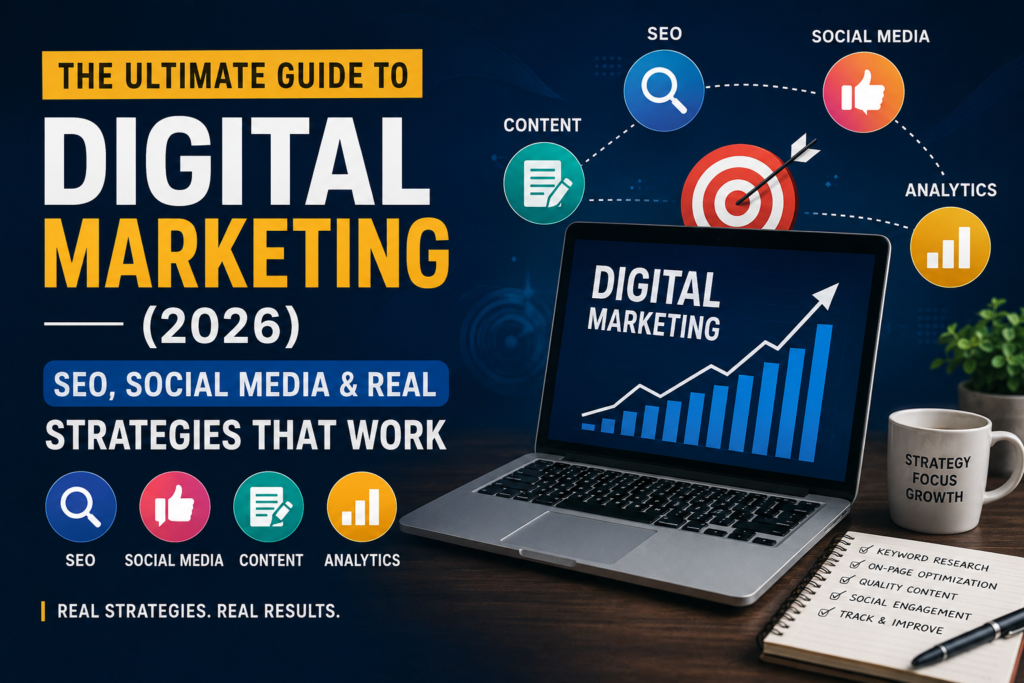
Digital marketing isn’t one skill — it’s a collection of moving parts that need to work together: SEO, social media marketing, content, and analytics. Instead of trying to cover every tactic under the sun, this guide focuses on what actually moves the needle, based on real client work.
We’ll walk through:
- A real client turnaround story
- The framework I use with almost every client
- The single biggest mistake I see beginners make
- Practical, actionable tips for SEO and social media marketing
A Real Client Story: From Invisible to Findable
One client I worked with came to me with a familiar problem — a limited online presence, low website traffic, and almost no leads coming through digital channels. Their website existed, but it wasn’t doing any real work for the business.
Instead of jumping straight into social media or paid ads (the tempting, flashy options), I focused on SEO first. Here’s why that decision mattered.
Why SEO came before anything else
Social media and ads can create quick spikes in visibility, but without a website that’s actually optimized to convert and rank, that traffic has nowhere useful to land. SEO builds the foundation everything else stands on. So the early work centered on:
- Researching the keywords their actual customers were searching for
- Cleaning up on-page elements — title tags, headings, meta descriptions
- Making sure page content actually answered search intent, not just stuffed in keywords
Within about one to three months, the client started seeing measurable improvements in both traffic and lead quality. Not overnight — real SEO rarely is — but steady and compounding.
That timeline matters, because it sets realistic expectations. If you’re expecting results in a week, you’re setting yourself up for disappointment.
The Biggest Mistake I See in Digital Marketing
If I had to name one mistake that trips up more businesses than anything else, it’s this: ignoring SEO basics and on-page optimization.
It’s an easy trap to fall into. SEO isn’t as immediately visible or exciting as a social media campaign or a paid ad. You can’t watch the “likes” roll in. But skipping it is like building a house with no foundation — everything else you do on top of it works harder than it needs to, or doesn’t work at all.
Common on-page issues I see repeatedly:
- Missing or duplicate title tags
- No clear primary keyword strategy per page
- Thin content that doesn’t fully answer the searcher’s question
- Slow page speed and poor mobile experience
- Little to no internal linking between related pages
Fixing these doesn’t require a huge budget. It requires consistency and attention to detail — which is exactly why so many businesses skip it.
My Go-To Framework: Keyword Research + On-Page Optimization
Every client engagement I take on starts in the same place: keyword research paired with on-page optimization. It’s not glamorous, but it’s the process that consistently produces results.
Here’s a simplified version of how it works:
| Step | What Happens | Why It Matters |
| 1. Keyword Research | Identify what your actual audience is searching for — not just what you assume they search | Ensures content matches real search intent |
| 2. Content Mapping | Match keywords to specific pages or planned content | Avoids keyword cannibalization and confusion |
| 3. On-Page Optimization | Optimize titles, headers, meta descriptions, and internal links | Signals relevance to search engines and readers alike |
| 4. Monitor & Adjust | Track rankings and traffic, then refine | SEO is ongoing, not a one-time task |
This framework works because it’s built on evidence, not guesswork. You’re not optimizing for what you think people search for — you’re optimizing for what they actually type into Google.
Bringing Social Media Marketing Into the Mix
Once the SEO foundation is solid, social media marketing becomes far more effective. Instead of using social platforms to generate traffic out of thin air, you’re using them to amplify content that’s already built to convert.
A few practical tips that consistently help:
- Repurpose, don’t recreate. Turn a well-performing blog post into three or four social posts instead of starting from scratch each time.
- Match the platform to the audience. LinkedIn works differently than Instagram — don’t post identical content everywhere.
- Use social as a discovery channel, not the whole strategy. It should point people back to owned assets like your website or email list.
Digital Marketing Guide: Quick Comparison of Core Channels
| Channel | Best For | Typical Timeline to See Results |
| SEO | Long-term, sustainable traffic and leads | 1–3+ months |
| Social Media Marketing | Brand awareness, engagement, amplification | Days to weeks |
| Paid Ads | Immediate visibility and testing | Immediate, but temporary |
| Email Marketing | Nurturing leads and retention | Weeks to months |
Final Takeaways
It’s not hard to do digital marketing, it just has to be done in the right sequence. Let’s look at what to focus on based on actual client feedback:
Investigate SEO and on page optimization before putting a heavy investment elsewhere.
Have reasonable expectations; they should take one to three months, not days to see meaningful results.
Enhance good content, don’t endorse without a strong foundation.
Revise and update your keyword strategy continually—it’s a continuous process.
Digital marketing is a system, not a collection of tactics. If you establish a solid foundation, everything else will work towards you.
Conclution
Digital marketing isn’t a matter of leveraging all of the channels and all of the opportunities for fast results. If you’re a business owner looking to strengthen your online presence, working with a digital marketing expert in Alappuzha can help you develop a practical strategy tailored to your goals and target audience.